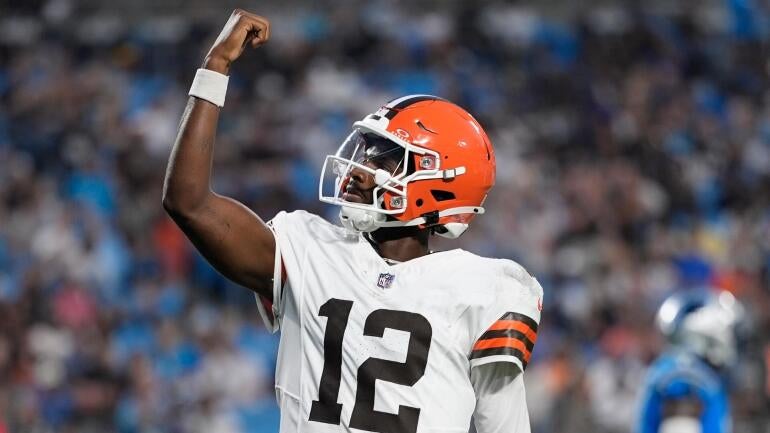


It wasn’t without flaws, but it was significantly improved. The game plan was straightforward for Shedeur Sanders in his inaugural NFL start: adjust the launch point, attempt some deep throws, incorporate quick passes to Harold Fannin Jr and Dylan Sampson, and allow Myles Garrett and the defense to perform.
Sanders completed 11 of 20 passes for 209 yards, with one touchdown and one interception on Sunday, marking him as the first Browns quarterback to earn a win in his debut since 1995, when Deion Sanders was still playing.
After the game, Kevin Stefanski was noncommittal about his starting quarterback for Week 13, but soon announced on Monday that Sanders will start again this Sunday against the San Francisco 49ers. However, it is clear that Sanders should not only start against the 49ers but should lead the team for the remainder of the season.
This situation has little to do with Dillon Gabriel, the team’s third-round pick, and more to do with the necessity for Cleveland to assess what they have in Sanders, who was selected two rounds later. With two first-round picks in the 2026 draft, the Browns are likely to select a quarterback unless either Gabriel or Sanders can emerge as the next Brock Purdy or Kirk Cousins, both late-round surprise successes.
With six games into the season, the evidence suggests Gabriel has not yet made that leap. However, the jury is still out on Sanders.
Reintroducing Gabriel as the starter yields no benefits; we already understand his capabilities as a player best suited for fundamentals, particularly on short to intermediate throws, yet he struggles with longer passes. In his six starts, Gabriel ranked last among rookie quarterbacks in big-time throw percentage (1.5%), trailing behind Jaxson Dart (5.9%), Tyler Shough (4.8%), Cam Ward (3.4%), and Sanders (6.3%).
Gabriel’s average depth of target also ranks last (6.4) compared to Shough (9.9) and Sanders (9.8).
After Gabriel took over for Joe Flacco in late September, I analyzed how Stefanski could optimize the offense for him. Many strategies remain relevant for Sanders, but the potential ceiling is higher.
It seems, however, that Stefanski appears hesitant to fully embrace Sanders compared to Gabriel, perhaps because he was eager for Gabriel prior to the third round and found it strange that the Browns opted to trade up for Sanders. Whether this sense of unease is real remains unclear.
A source in the league once conveyed how Stefanski is adept at helping players excel within their comfort zones, modifying strategies to maximize quarterback success. This message may have been misunderstood throughout Gabriel’s stint.
Sunday’s game in Las Vegas clarified that Sanders possesses qualities worth pursuing.
Sanders completed 55% of his attempts but displayed remarkable improvement in pocket presence compared to the previous week when he had minimal first-team reps. In the match against the Raiders, there was far less indecision in the pocket, and he was quickly releasing the ball. His rollouts simplified his progressions, and he confidently threw downfield, which included a 55-yard aerial strike to Isaiah Bond.
Despite facing an interception after misreading Charles Snowden, who he thought was in coverage but instead made a play on the ball, Sanders rebounded well. Later, he displayed poise by connecting with Jeudy down the field after rolling out and resetting his stance.
Statistically, Sanders ranked favorably against his Day 3 counterparts, only trailing in EPA per dropback, while achieving high levels in yards per attempt, explosive plays, and deep-ball throws.
The Browns, underwhelming in their performances, hold the sixth pick in the 2026 draft alongside the Jaguars’ 22nd pick from the Travis Hunter trade. Since 2010, there have been instances where teams drafted a quarterback in the first round a year after selecting one in any round, indicating a past trend of teams rapidly addressing perceived quarterback shortcomings.
While the past ten occurrences of teams drafting ’the name before the name’ have demonstrated the urgency to rectify mistakes, it is clear that if Sanders doesn’t prove to be the answer—similar to Shough, for example—Cleveland could look towards securing a first-round quarterback in the upcoming draft.
Now is the time to grant Sanders the opportunity to prove he can be a long-term solution for the Browns or simply another name before the inevitable need for what’s next.