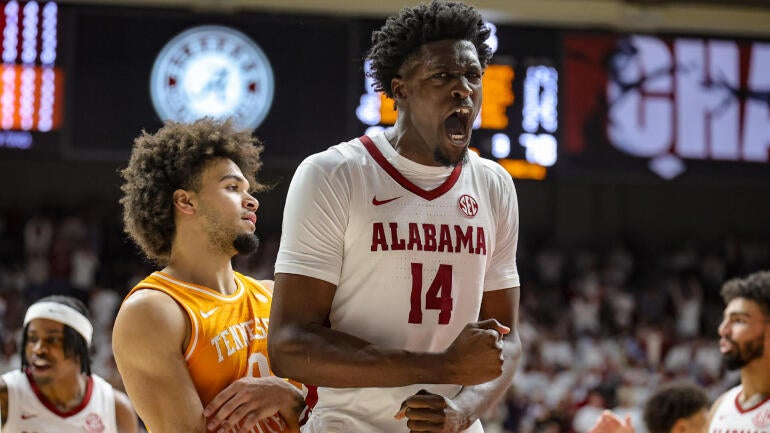
Cheering for Change: Alabama's Charles Bediako Returns Amid Controversy
A judge's ruling allows Charles Bediako to return to Alabama basketball, igniting cheers from fans who defy NCAA protocols.


TUSCALOOSA, Ala. – If this was the end of college basketball as we knew it, it finished with a rousing ovation.
As Charles Bediako, a 23-year-old who was recently with the G League’s Motor City Cruise, received a standing ovation when he entered the game with 16:11 left in the first half, supported by many of the 13,474 Alabama fans present at Coleman Coliseum.
Bediako’s quick impact was visible as he scored four points upon entry, culminating in a dunk that energized the crowd again. Despite an eventual loss to Tennessee (79-73), the Crimson Tide fans celebrated his return, defying NCAA regulations.
He finished the game with 13 points, two blocks, and three rebounds in just 25 minutes of play.
“I thought he was good,” said Alabama coach Nate Oats. “He almost led us in blue-collar points. He’s a great teammate and will help us moving forward, but he needs to improve his rebounding.”
The return of Bediako not only underscores the team’s need for depth but also sparks discussions about the future of college basketball amidst evolving regulations.
Bediako faces another hearing where he may secure his spot on the team for the rest of the season. Following the game, he stated, “My main focus is on the next game and improving with the team.”
The shifting landscape of college sports raises questions about the involvement of former NBA players in college, as Bediako’s case signifies a larger trend.
What’s Next for College Basketball?
Bediako’s case isn’t isolated. The actions of other schools suggest that bringing in former professional players could become standard practice in college sports.
Fans and analysts are grappling with the implications of this trend, and figures like Mitch Gilfillan and Scott Schneider have highlighted the structural challenges facing the NCAA as it struggles to maintain control.
As this saga unfolds, one thing is clear: Following the pulses of local support, schools willing to challenge NCAA authority could reshape the landscape of college athletics.